
...
Allocation - global algorithms
...
24. MultiDiamond
...
and
...
24. MultiNext
...
algorithms
Include Page Video | Algorithms "24. MultiDiamond" and "24. MultiNext" Video | Algorithms "24. MultiDiamond" and "24. MultiNext"
24. MultiDiamond
Allocation of 3 (three) or more diamonds has become the standard for all sizes and types of rough stones. On average, a solution contains 5 (five) diamonds. An important question when allocating multiple diamonds is "How to perform Sawing?" Not all solutions with 4 (four) or more diamonds can be sawn using modern sawing technologies.
The picture shows an example that cannot be sawn.: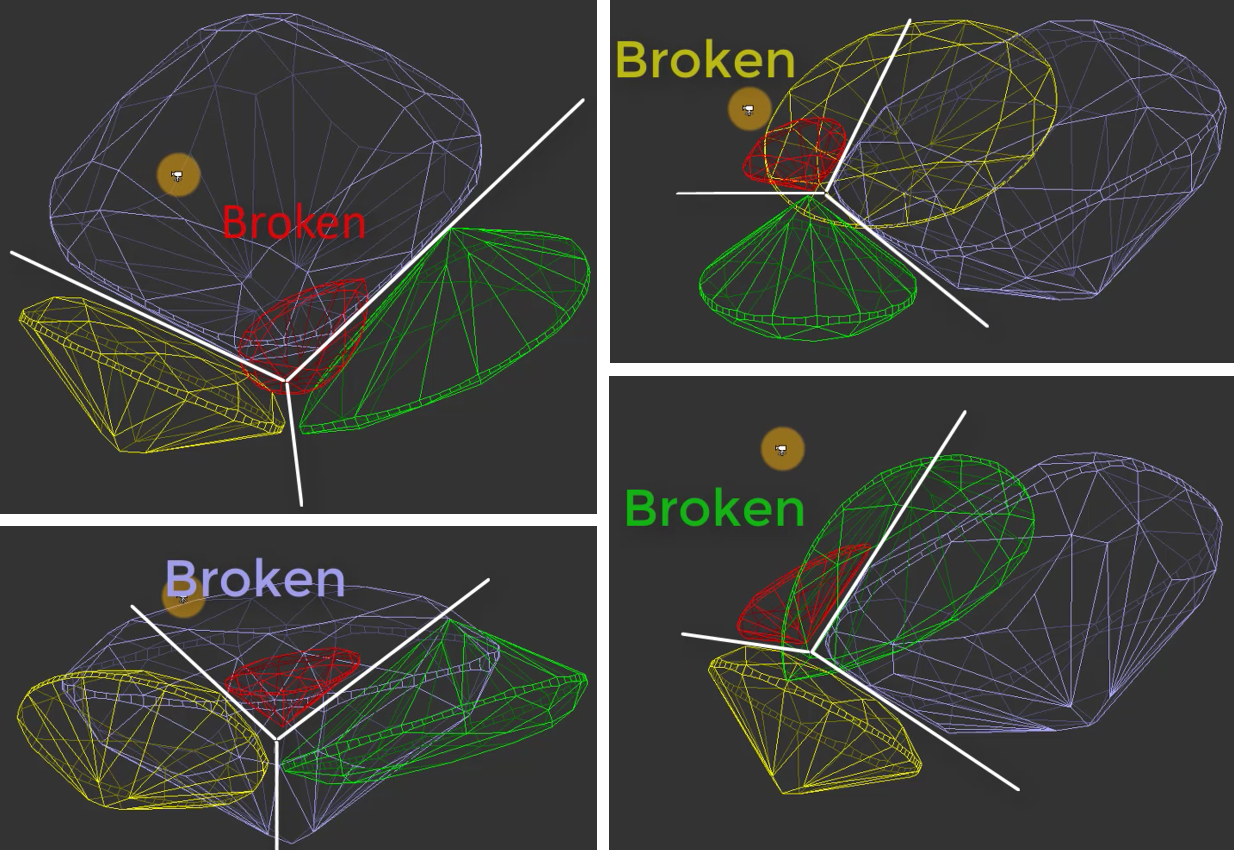
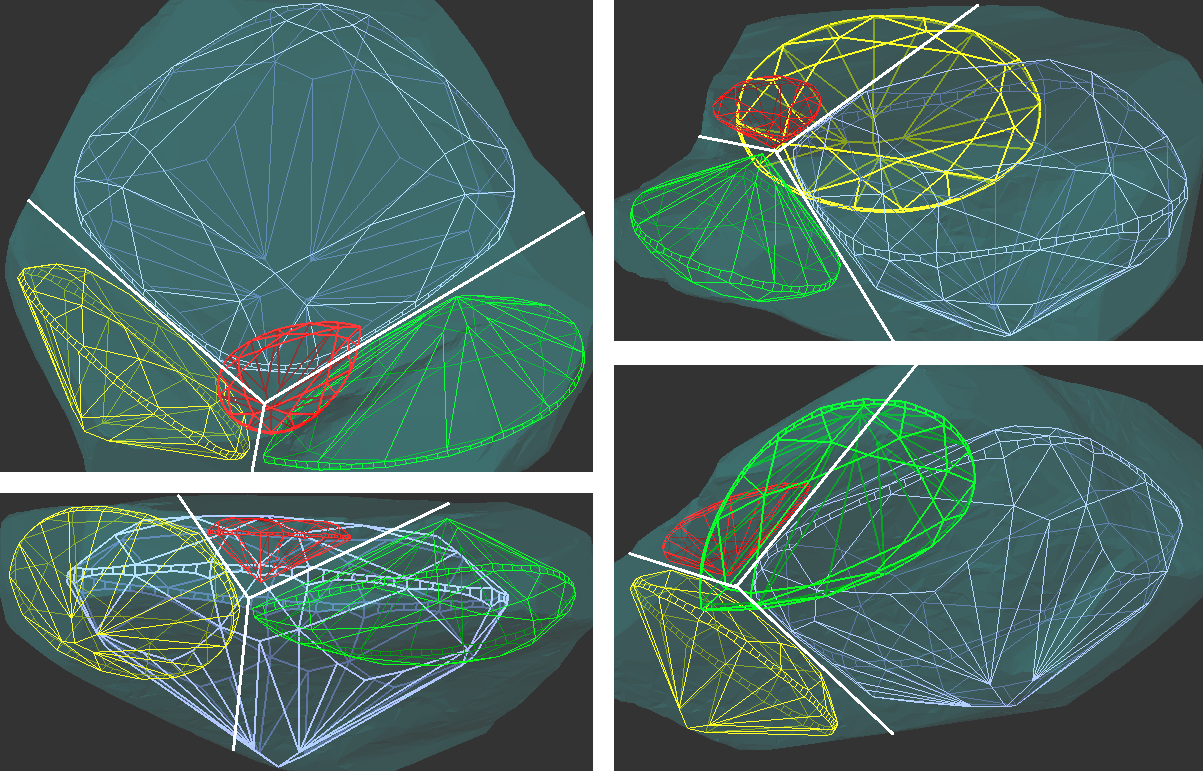
Introducing our the new algorithm " 24. MultiDiamond."
Solutions from generated by the " 24. MultiDiamond " algorithm can always be sawn, and we provide a sequence of sawing layers and pies to guide this process.
Users can specify the desired number of diamonds they want in a solution, and the algorithm will find allocate that many exact quanitty of diamonds in the scan model.
When searching for the 3 (three) largest diamonds, the algorithm prioritizes maximizing price. From 4 (four) diamonds onwards, the algorithm also considers the need for existing sawing.
...
Furthermore, users can adjust the thickness of sawing planes used in the optimization process, and choose the "Variation" mode. Currently, two options are available:"
- FixedForm
...
- to produce solutions exactly of the same form as the allocation forms registered within the cut. Only scale or position may be changed;
...
- FlexibleForm
...
- to produce solutions in the limits specified by the appraiser.
24. MultiNext
The algorithm "24. Multinext" has also been added. It operates on one or multiple selected solutions. The user chooses how many extra diamonds need to be added to the selected solutions. In the case of multiple selected solutions, the algorithm will work independently and in parallel on each of them. "24. MultiNext " algorithmuses a an allocation method identical to " 24. MultiDiamond" starting from third solutions. The result of "24. MultiNext" can can always be sawn with pie sawing.
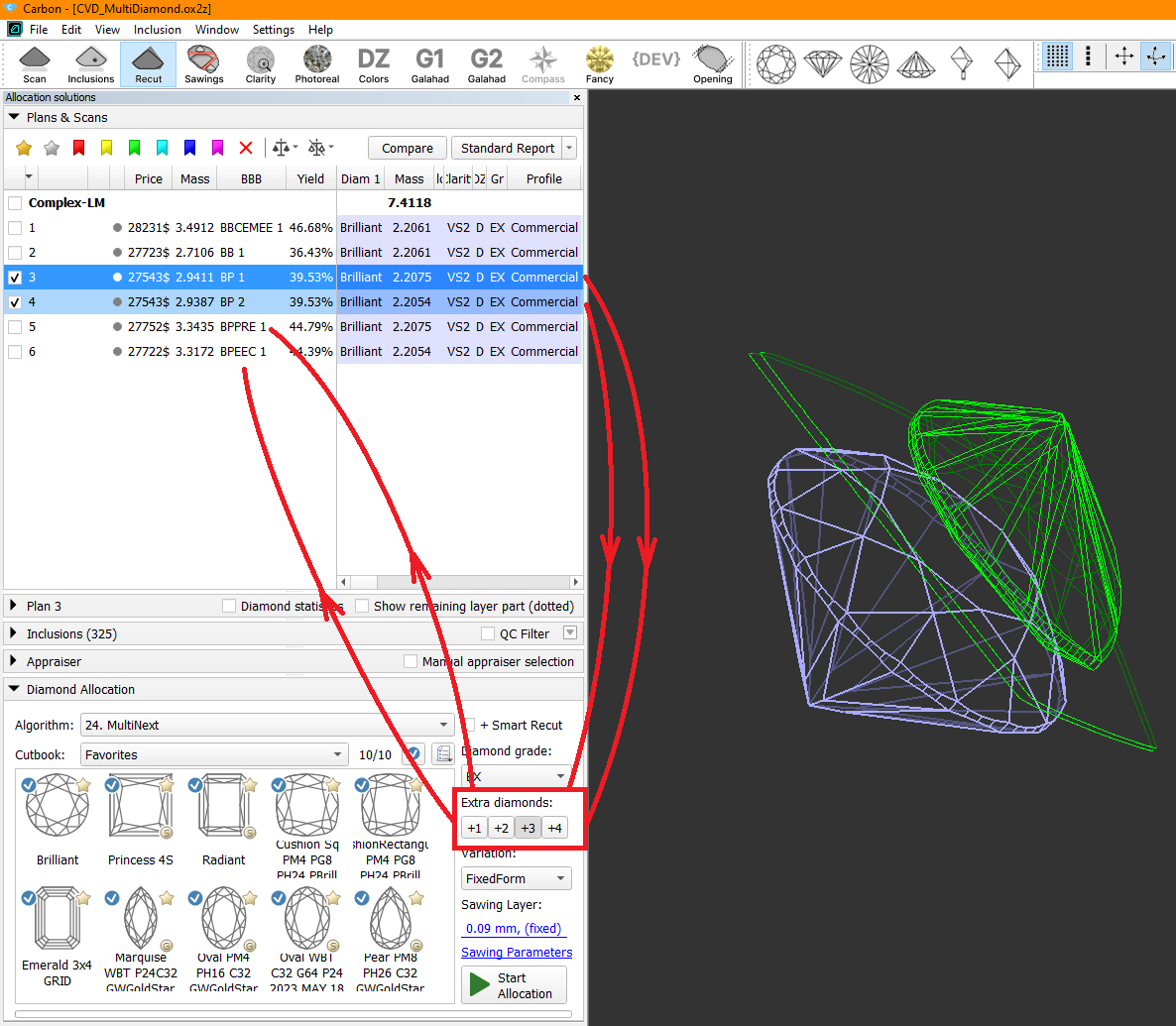
The "24. Multinext" algorithm (similar to decribed above " 24. MultiDiamond " algorithm) provies two options in the Variation dropdown menu:- "
- FixedForm
...
- to produce solutions exactly of the same form as the allocation forms registered within the cut. Only scale or position may be changed;
...
- FlexibleForm
...
- to produce solutions in the limits specified by the appraiser.

The "Compared to thу previously released 24. MultiNext " algorithm with choosen (FixedForm option, compared to previuosly released in ver. , BasicSawing) algorithm in HPCarbon version 2.0.9 "9m the new 24. MultiNext (FixedForm, BasicSawing)"algorithm with choosen FixedForm option:
- Is faster;
- In most cases provides higher solution price;
- Creates solutions that frequently cannot be sawn without using Pie Sawing.
...
25. Semicut (final)
...
algorithm
| Include Page | ||||
|---|---|---|---|---|
|
Introducing the updated algorithm : "25. Semicut (final)".

This method is used for semipolished stones to ensure that the solution maintains the Table normal of the scanned model. This allows for the cutting of other facets without altering the Table facet angle.
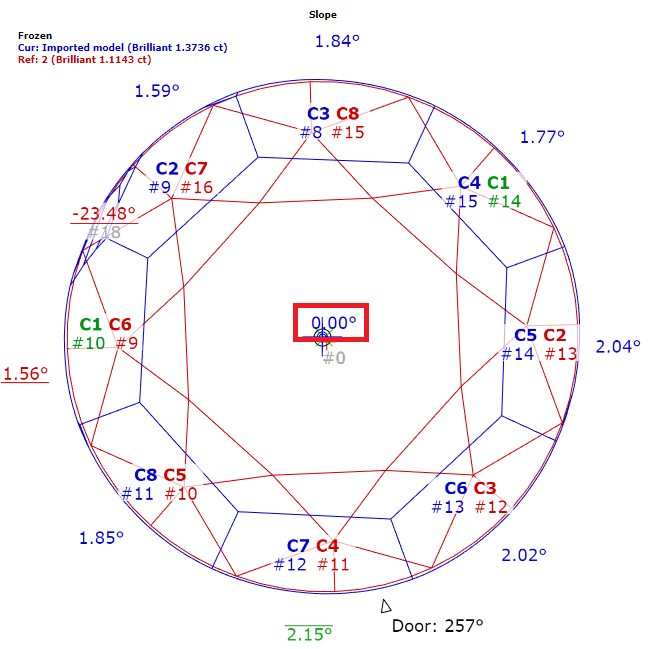
Key advantages over the "06. Semicut (final)" version algorithm:
It uses preforms to increase the solution's weight.
It features improved adjustment of the solution's rotation around the Table normal to find the optimal weight.
It is built on the " 23. Single " algorithm and incorporates all its modern features.
On semipolished stones with a defined Table facet and girdle, " 25. Semicut (final) " with the Brilliant cut shows an average improvement of 0.5% in mass and 1% in price compared to " 06. Semicut (final)". The average processing time with one cut is approximately 3 seconds.
Algorithm
...
25. Chess
...
Multi-diamond optimization algorithms primarily operate on a greedy principle. Each subsequent diamond tries to maximize its own volume, paying little attention to the space it leaves for the others. This greed can lead to inefficient use of the original rough's space. While various balancing techniques exist—where earlier diamonds yield some of their space to later ones to increase the total value—the problem becomes intractable within a reasonable time as the number of diamonds increases and the rough becomes more complex due to cavities and inclusions. This forces a reliance on the initial luck of the greedy approach.
...
This standardization of the input data allowed us to create a new algorithm based on principles from the theory of packing space with identical objects.
Introducing the "25. Chess" algorithm algorithm.
It works by first constructing an optimal cutting lattice for the entire volume and then searching for the best diamonds within it, taking into account the specifics of the input model and inclusions.
...
This algorithm is more efficient than greedy methods. And as CVD diamonds become purer over the years, the results of the "25. Chess" algorithm will become increasingly flawless. It also allows for for finding multiple diamonds of similar mass from the same rough, which carries additional value.
The algorithm is currently under active development and can be considered a demo version. It fully supports only the " Brilliant " cut. You can select a different cut, and the algorithm will will search for it it during the selection phase, but the optimal cutting lattice will still be built for the " Brilliant " cut. In future updates, we will add full support for other cuts, starting with rectangular StepCuts.
...